
Stronger beginnings - just not yet
Checking in on Australian reforms to initial teacher education

US education think-tank the Thomas B. Fordham Institute recently released a paper titled From the Teacher’s Desk: A Science of Reading Progress Report. The paper reports the results of a survey of American K-3 reading teachers which assessed their knowledge of some basic principles of reading science. Here’s the main findings:
At least a third of teachers in high-poverty settings aren’t fully committed to the science of reading
Teachers who rely on their preservice training know less about the science of reading than teachers who receive in-service training
Teachers in states with science of reading-aligned licensure tests have a firmer grasp of reading science
Many teachers are still using questionable reading curricula
Robert Pondiscio of the American Enterprise Institute has some incisive commentary about the bigger picture, writing on his blog The Next 30 Years: The Future of Education Reform:
If the science of reading has not fully won the classroom, one reason might be it has not yet won ed schools that prepare the people who work in them. The Fordham report contains a devastating finding: Teachers who rely on their preservice training know less about the science of reading than those who learn it on the job. Worse, teachers who report learning about the science of reading in their preservice programs demonstrate lower knowledge of it. Read that sentence again.
This is not a minor implementation hiccup, it’s an indictment. It suggests that the institutions responsible for preparing teachers may be miseducating them at scale about the most foundational skill they are expected to teach.
This is not a trivial problem, it strikes at the foundation of reform. If teacher preparation programs are sending candidates into classrooms with a weaker grasp of reading science than they acquire later on the job, policymakers cannot treat this as business as usual. State leaders and education agencies must make strengthening preservice training an urgent priority and wield the power they hold over accreditation and licensure to ensure that new teachers enter the classroom ready to teach reading effectively from day one.

The US is lagging in the sense that its public discussion hasn’t really gone beyond the science of reading, but the dynamic identified by the Fordham report and Pondiscio’s blog is not an unfamiliar one to Australians: it relates to the gap between policy and implementation.
Stronger beginnings
One of the findings from my February 2024 report Implementing the Science of Learning: Teacher Experiences was that for science of learning-informed practices to scale, teachers need an accurate yet accessible knowledge base, because they don’t currently get one from their initial teacher training and are forced to build knowledge in an ad hoc way.
The majority of research participants, especially leaders, nominated ITE as a significant barrier to SOL practices and expressed a desire to see reform to university coursework and the pre-service teaching program to align with SOL principles:
Certainly if you don’t know about [the science of learning], then that would be a barrier [to adopting it]… it’s still not taught in all universities where they train teachers, so a large majority of teacher training.
[W]hat they’re teaching at universities, they’re not learning any of this stuff. They’re not being taught about cognitive science at uni… [the] science of learning, none of it.
[W]e really need universities involved, right, initial teacher education. That is so a fundamental key to bringing forth real change over time.
When asked to describe barriers to more widespread adoption of science of learning practices, an almost universal comment was the content and quality of ITE — specifically, that it did not teach pre-service teachers or graduates what they did need to know and, in many cases, actively taught them things that would hamper their ability to be effective teachers. Where there is a desire for change at a leadership level of a school, the burden of retraining and professional development becomes significant.
Now, the data collection for this report pre-dated the release of the Teacher Education Expert Panel’s Strong Beginnings report in July 2023. That report, agreed to by all Australian education ministers, said all providers of initial teacher education had to embed (or be on track to embed) the recommended core content by the end of 2025.
As a refresher, here’s what the core content includes:
1. The brain and learning: content that provides teachers with an understanding of why specific instructional practices work, and how to implement these practices.
2. Effective pedagogical practices: practices including explicit modelling, scaffolding, formative assessment, and literacy and numeracy teaching strategies that support student learning because they respond to how the brain processes, stores and retrieves information.
3. Classroom management: practices that foster positive learning environments.
4. Responsive teaching: content that ensures teachers teach in ways that are culturally and contextually appropriate and responsive to student need. This includes core content on:
First Nations peoples, cultures and perspectives
cultural responsiveness, including students who have English as an additional language/dialect (EAL/D)
family engagement for learning
diverse learners, including students with disability.
A framework for a roadmap for an implementation plan agenda
Needless to say, the response from industry was not terribly positive, although many of the teachers I know - who resonated with the quotes from teachers I extracted from my report - were cautiously optimistic.
Almost three years on from the report’s release, it’s worth checking in on how these reforms are going.
In April 2024, the education ministers appointed an Initial Teacher Education Quality Assurance Oversight Board, which is mostly made up of various government and agency representatives, some sectoral representatives, and ITE academics, including Emeritus Professor Bill Louden, who was the deputy chair of the TEEP.
This Board has a terms of reference (June 2024) ten pages long, but mostly their role is to determine whether ITE programs “have evidence-based practices embedded in them” and “are meeting the core content requirements”. They also have to report their annual work plan to the bureaucrats, national and sub-national, who have responsibility for school education.

How are they going with it all?
Well, their first work period began on 1 July 2024, and ran to the end of the 2024-25 financial year, and on 20 April 2026 - yes, that’s right, 8 months after the end of said financial year - they provided the 2024-25 Annual Report to the education minister Jason Clare, in his capacity as chair of the Education Ministers’ Meeting. It was published online on 4 May. Here’s what their foreword letter to Clare says:
Our progress on the Board’s five key projects has been substantial. We have initiated a national approach to verifying the implementation of core content in ITE programs, including the development of an ITE graduate survey and a robust methodology for course material review, and established an understanding of information-sharing principles and arrangements to underpin this work. We have advanced the cross institutional moderation of Teaching Performance Assessments (TPAs), ensuring greater consistency in how graduate teachers are assessed. We have overseen the development of a national dashboard of ITE indicators, providing transparent insights on key ITE measures. We have supported the streamlining of reporting requirements to reduce administrative burden while enhancing accountability.
I read government reports for a living and even I don’t want to read any further - but I will press on, because it’s important.
The report tells us most ITE providers have either completed or are on track to complete the ‘verification process’ (what that means is not stated) by the end of 2025.
As at October 2025, out of the 47 ITE providers: two had already completed the verification process; 38 were on track to embed core content by the end of 2025; one provider is withdrawing from the higher education sector and hence will not offer an ITE program in 2026. The Board will continue to monitor the remaining six providers, which are expected to meet accreditation requirements by February 2026.
Which institutions fall into which category are not named. Nor has the report - remember, not sent until April 2026 - been updated to reflect whether the 38 providers who were on track for the end of 2025 did in fact meet their accreditation requirements, let alone the six providers who were on track for February. I suppose it takes too long to change a couple of sentences in a report.
The QAOB asked AERO to develop a quality assurance methodology for the ITE providers, and the providers themselves were invited to offer input into the framework. This is termed ‘stakeholder engagement’, but it seems more like letting universities who have failed the grade already make suggestions about how the next assessment should be marked. The work of actually reviewing the materials will be subcontracted out to someone else, and the report takes pains to note that they’re not really expecting much to be properly aligned across 2026 and 2027. Again, if they haven’t actually come up with a finalised methodology for core content verification and quality assurance, what standard have these providers been marked by, exactly?
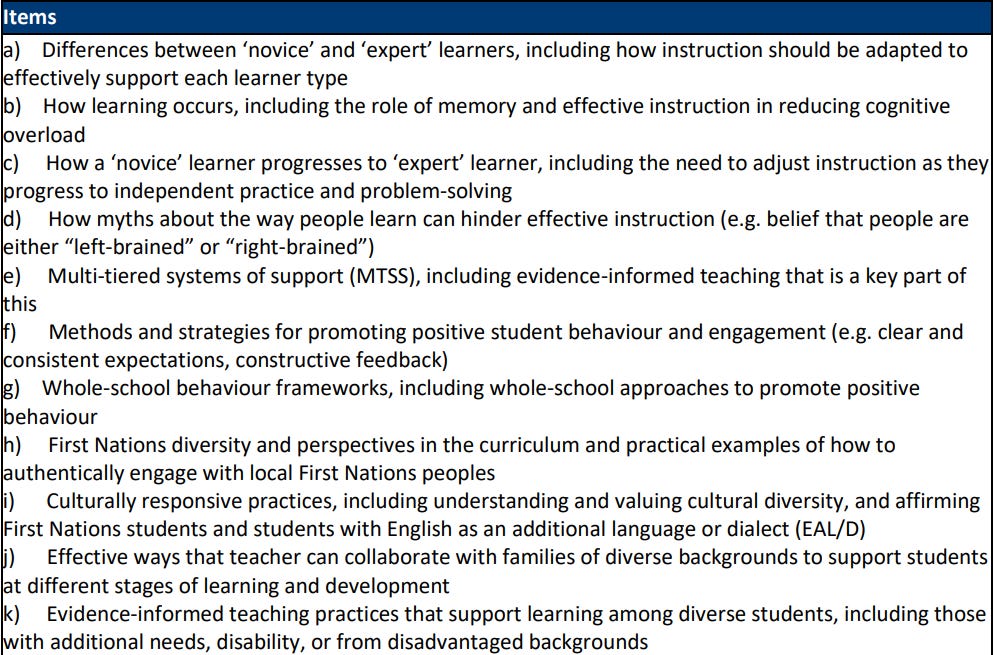
In September 2024, the QAOB also got academics from UNSW - Professor Andrew Martin, of load-reduction instruction fame, and Professor Rebecca Collie, in the educational psychology department - and the Social Research Centre to develop a survey instrument of ITE final year students and graduates, called the ‘ITE Perceptions Survey’. This was then field trialled in November/December 2024. The survey essentially asks teachers to self-report a) how knowledgeable they feel about certain ideas and b) how confident they feel about enacting certain practices in the classroom.
Knowledge items
Confidence items
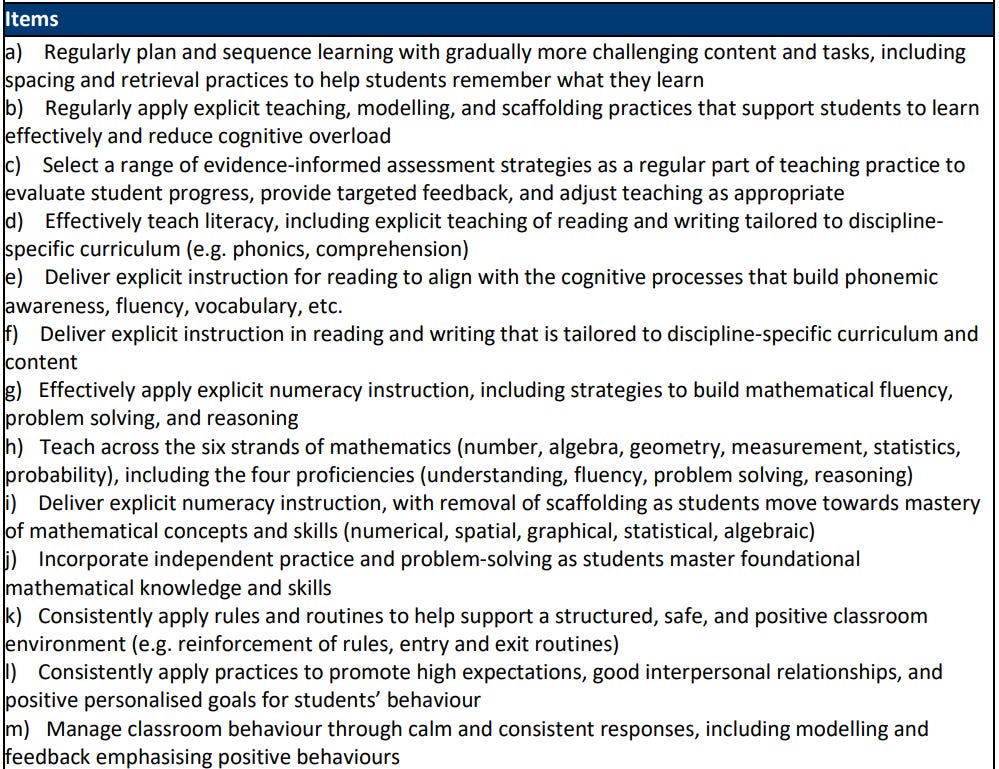
This is the equivalent of asking students to do Fist to Five to check whether or not they’ve learned something. Please, somebody look up social desirability bias. It’s one of those basic things they teach you in any methods course relating to survey design.
But that’s okay, who needs a survey when we have a high quality assessment that measures teaching performance, right? Right?
This brings us to the Teaching Performance Assessment, aka ‘that stupid portfolio the university makes you do (and if you’re in Victoria they make you do something similar all over again to get your full VIT registration’). This is something the QAOB has sought to run moderation sessions on.
Results indicate that despite the use of TPA samples and assessors from across the participating TPAs to form the single scale, it was not possible to find a relationship between the classroom readiness estimates and the assessment of samples as below or at standard by the TPAs. This suggests there is not a consistent standard of classroom readiness to determine whether students pass or fail the TPA.
I, for one, am simply shocked that this is the case. It’s almost like an assessment is not a useful indicator of performance when the people making and marking the assessment haven’t taught the same curriculum and don’t even have a shared understanding of what good performance looks like.
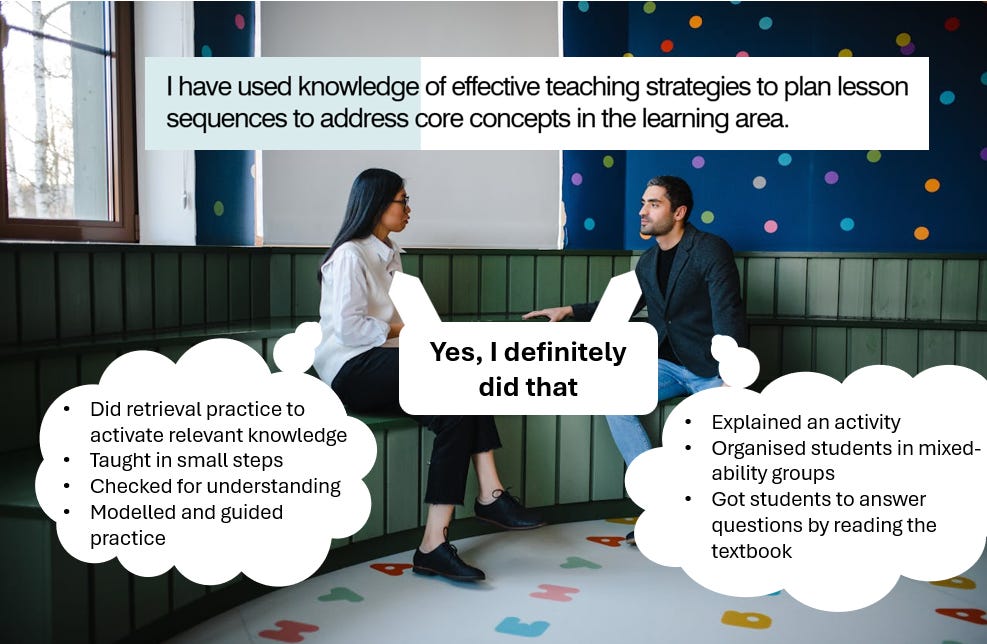
Not to mention, all of this stuff is designed to align to the Australian Professional Standards for Teaching which is… problematic, to say the least.
Hastening slowly
Anywhere between 15,000 and 17,000 students graduate from ITE programs every year.1 Between the report’s release in 2023 and the end of 2026, upwards of 60,000 people could have graduated from ITE and entered Australian classrooms without the knowledge the education ministers all agree is critical to building teachers’ capacity to lift student outcomes.
Don’t forget, too, that the universities were provided with special funding from the Strong Beginnings Transition Fund to actually, y’know, do their jobs in effectively training future teachers.
Can you imagine being a teacher having been short-changed by your degree, still having to pay for it, and knowing the federal government is saying “hey guys I know you can’t do your job but here’s a sack of cash to maybe do your job from now on? Please?” to the people who have made bank from you while you struggle in the classroom?
One of the most telling things from the annual report of the ITEQAOB is how it conceptualises ‘stakeholder engagement’. In every respect, the ‘stakeholders’ are the university providers.2 The stakeholders are never the actual teachers who have spent hours of their life and thousands of dollars for a poor quality education. Nor are they the taxpayers whose financial support - via commonwealth subsidised places - makes the existence of these programs possible. And they are certainly not the children in schools being taught by teachers who could have been trained to be more effective, but weren’t, because some deluded academic associates explicit instruction with dogma and the church or some rubbish.3
In the almost three years since the release of the Strong Beginnings report, five months after the universities are supposed to be compliant, what do we actually have to show for this landmark reform of ITE? Virtually nothing.
Burn it down and start again?
It doesn’t seem like policy from above, whether it’s for changing how initial teacher education programs run or how teachers run their classrooms, really works in isolation. So the next question is, what can be done to improve the education and training future teachers receive when they enter the classroom?
What’s really needed is to create institutionally-neutral ways to certify teachers. Essentially the only way to become a teacher in Australia is to do a degree at a university, and tinkering at the margins - e.g. giving Permission to Teach to people engaged in an employment-based pathway - doesn’t really change that. If very few universities are delivering outcomes in line with the core content, what is the purpose of letting this sector maintain a monopoly over a nationally critical section of the workforce?
Instead, look to New Zealand, where a registered training organisation - the New Zealand Graduate School of Education - is deemed to validly provide teacher training in that country. I’ve seen the work they do first-hand on a previous visit to Christchurch. Look also to England, where School-Centred Initial Teacher Training means schools - whose practice was shifted significantly due to the combined effects of Gove and Gibb reforms - can train teachers for the classroom directly.
Our Catholic school system, which collectively educates about one-fifth of students, could have a lot of clout in this space as a significant employer of future teachers. Many Catholic dioceses have been early adopters of science of learning-based approaches to teaching, but it is painful, expensive and time-consuming to have to reinvent the wheel of teacher knowledge due to sub-standard university instruction. This is an area ripe for the Catholic sector to flex its muscles.
Finally, this is an area that requires some political attention. The national conversation is consumed by talk of tax reform in next week’s budget and the cost of living crisis and petrol prices and what have you, and Minister Clare’s main job has been managing universities in terms of international student numbers.
But this matter requires urgency, and it requires more action from policymakers to ensure that the core content represents an entitlement for Australia’s future teachers, and the children they teach. Just because the people in universities are the visible stakeholders, that doesn’t mean they’re the most important.
It was around 16,000 in 2023 according to AITSL
If I were cynical, I would observe that a significant proportion of people on the board are affiliated with universities, so it’s not that surprising they consider their own sector to be the most relevant stakeholder
An actual example relationship from a concept map exercise I had to do in my ITE.
I have it on good authority that universities are now teaching critiques of CLT alongside a highlights tour of CLT. (De Jong, Claxton and friends)