
The Classroom AI Reality Check
New evidence on why AI’s most likely classroom uses may fall well short of its most productive ones.

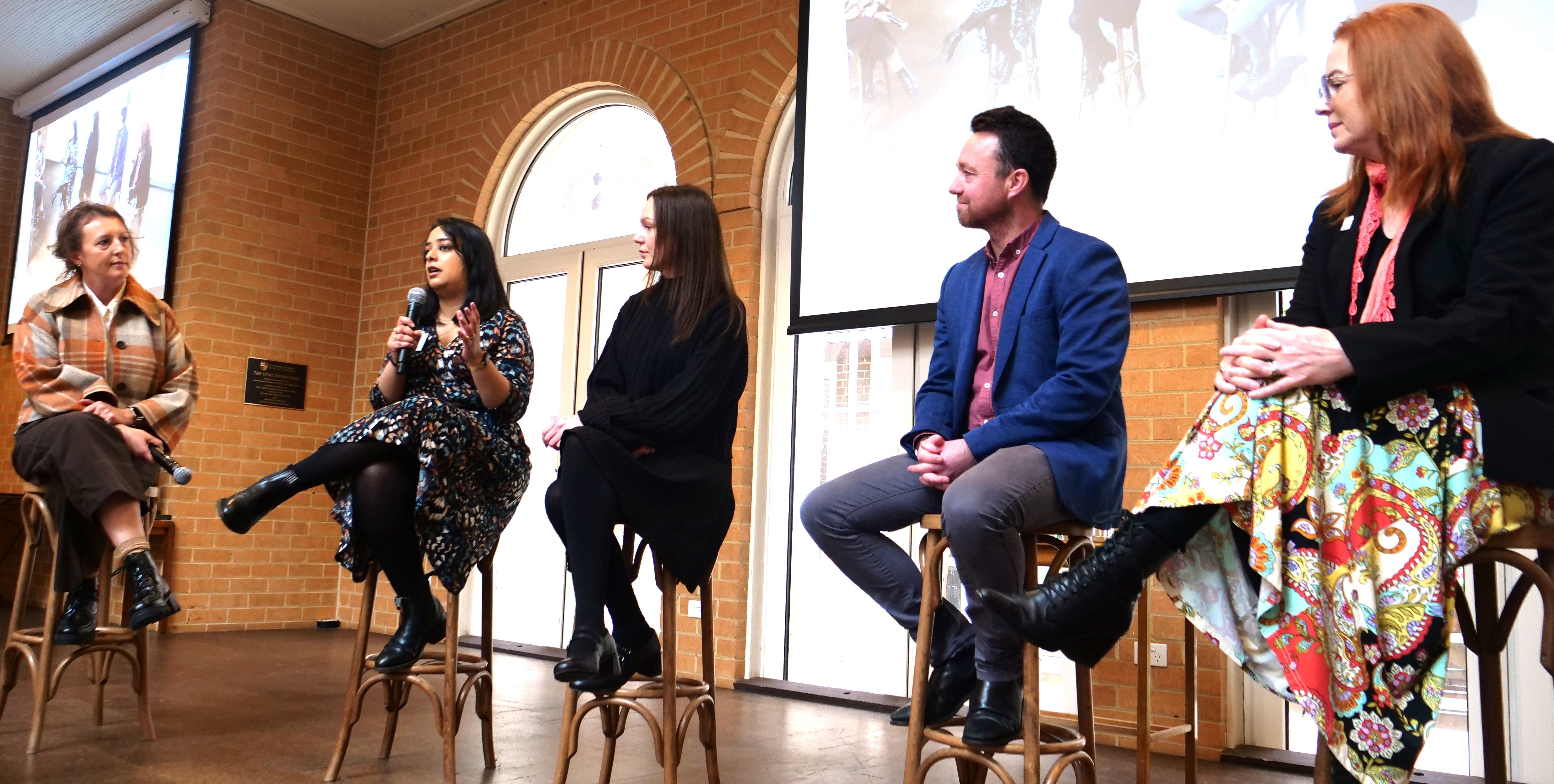
Last week I had the pleasure of contributing to a panel about educational equity in the age of AI, part of Teach for Australia’s Mid-Year Intensive/Alumni Community Day.1
The big question that was discussed by the panel is whether AI is going to be good for student learning, or whether it’s another risky edtech fad that will detract from learning.
But the relevant question is not whether AI is good or bad for learning in the abstract. It is what teachers and students use it to do, whether those uses improve learning, and what capabilities may be lost in the process. A related point is that the optimal use is not necessarily the most likely use, meaning policymakers have to design tools, frameworks and policies that acknowledge real-world realities. This is the kind of sober analysis that was missing from previous edtech fads, like the BYOD (bring your own device) push which is only now starting to be rolled back.2
Two recent studies shed light on what teachers and students actually do with AI, and what happens to student outcomes:
AI use in schools - Pearson and Jensen, May 2026. Published by Learning First.
Generative AI Can Harm Teaching - Sungu et al, June 2026. Covered in The Hechinger Report
What follows is a reflection on these two reports and some of my work and thinking on this topic to date, specifically in the context of my science of learning work.
Teachers’ main use of AI tools is to develop curriculum resources
Learning First did a survey of almost 3400 teachers and over 750 school leaders across all three school sectors in New South Wales to find out how teachers and students are using AI tools. They also did focus groups and interviews with non-school organisations like sector bodies and subject associations.3
Three-quarters of teachers surveyed use AI to develop curriculum resources, with the second most common use ‘helping with administrative tasks’.4
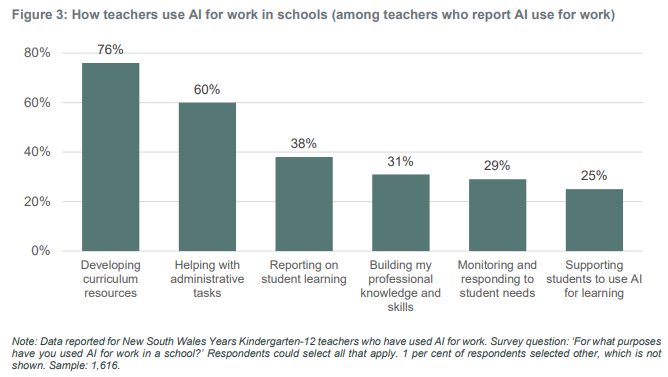
Pearson and Jensen quote from teachers directly who describe AI as “a real time saver” when used for planning, noting it can “almost create a bespoke textbook”.
They also state (emphasis mine):
Using ChatGPT and other general-purpose AI tools for education-specific tasks such as developing curriculum resources can be problematic. These tools do not reliably use a theory of cognitive architecture that aligns with how students learn best. This is not to say that teachers should continue to bear the unrelenting brunt of their workload and distrust any innovation that might help them do their job. AI can add value to teachers’ practice, but only when the tool is purpose-built for education, designed in consultation with education experts, and rigorously tested.
That is exactly why I argued in my submission last year to the Productivity Commission:
While it is possible that custom-made tools will be more effective, AI tools can only function in ways that aggregate existing ways of thinking about lesson planning, namely, with a focus on diverse activities and discovery learning.
But time saved is not necessarily the same as instructional productivity. Curriculum development is a full-time job. It requires knowing the written curriculum, understanding what is essential to achieve the goal, being able to separate that into multiple goals over the course of a unit, how that relates to prior knowledge, then to design lesson-level explanations, modelling, guided practice and independent tasks, with progression through the lesson mediated via formative assessment which should also enable real-time adjustments of the material. That’s just the tip of the iceberg; I could go into infinitesimally more detail. It’s a lot to deliver in the moment, let alone design in advance on your own or even in a small team.
General AI tools are not suited for this purpose. While it is eminently possible they can be used to assist teachers in developing some curricular-related items, the teacher has to stay in charge. There is a significant amount of difference in using AI to lay out a worksheet or create a graphic that would otherwise take lots of searching online or fiddling in Word or PowerPoint.
Thinking back to my time as a Spanish teacher, the possibilities are endless: I could create video cartoons using target language to set as listening/viewing comprehension tasks that contribute to a lesson objective I have planned. Because I control the language, I am not forced to find some random thing online that happens to use a slightly different word for ‘brown’ than the variations I have taught my students and risk confusing them. It would help me to be more precise in planning that part of the lesson for the same or less time input, creating more space to think about what I want students to do with that artefact.
Following Daisy Christodoulou, Pearson and Jensen call this keeping a ‘human in the loop’.

AI places greater demands on professional knowledge, not fewer
But to be able to use AI to create precise instructional materials, it’s a necessary condition for teachers to first value and try to pursue instructional precision and then second have enough knowledge of the curriculum and instructional design to know how to best pursue it. That also includes knowledge about how students learn: concepts such as working memory, schema development, attention and the environment, as well as how to translate these ideas into teaching approaches.
A teacher with a sound, if not expert, understanding of how to knit all this together could probably use AI to deliver a much better quality lesson than what they could do on their own. But that teacher is not representative5 and policy cannot be designed around the putative ‘expert user’. In considering the risks and benefits of AI, one has to consider the median teacher. As I said slightly more casually in in my last blog post that touched on AI:
…off the shelf LLMs are likely to just multiply the quantum of edu-bullshit making its way into Australian classrooms, not reduce it. Bureaucratic buzzwords like ‘quality assurance’ and ‘alignment’ are unlikely to be terribly helpful because the real problem is the absence of deep professional knowledge across the whole profession…

In other words, when more teachers believe that students learn better if their ‘learning style’ is catered to than know about the specific limitations of working memory, we are likely to get GIGO: garbage in, garbage out.
Students’ main use of AI tools is task completion, not learning enhancement
While teachers don’t necessarily understand all the details of the cognitive processes involved in learning, they do argue students are using AI as a replacement - not an enhancement - of their thinking and have an intuitive sense that less thinking will lead to less learning:
One of the things I'm concerned about is the process of thinking. They [students] don't develop that and they just arrive at a conclusion and an outcome. [AI] is not helping them to be thinkers…they just want to get to the destination. So they're losing the value of learning itself as a journey…I think it [students’ thinking] is being dwarfed and snuffed.
One of the major difficulties that I've encountered is that for some students, their expectation of what generative AI tools should do is to offload close to 100 per cent of their own cognitive effort.
Given the top two most common uses by students is completion of assessment tasks and homework ‘assistance’, this potentially represents a significant amount of lost learning effort.6
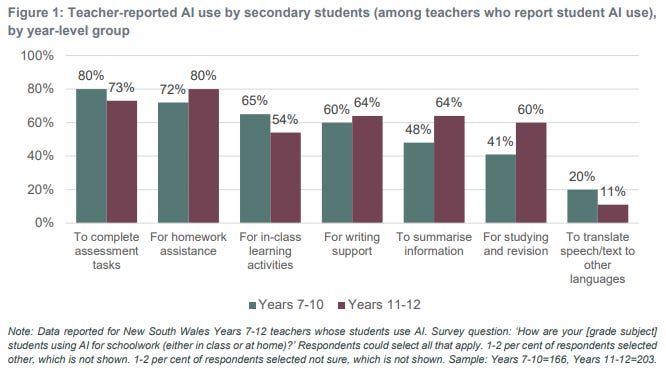
As Pearson and Jensen note up front, by mostly interviewing teachers, the results reflect the best of teachers’ estimation on the topic of student usage. But one of the findings was that many teachers don’t think they can detect all the ways AI might be used by their students - meaning the data above may represent an underestimation of actual use.
To be clear, there are potential student uses of AI that enhance learning. A student with a good grasp of the testing effect in cognitive psychology and the benefits of retrieval practice could use an AI tool to generate flash cards for self-quizzing, a spaced retrieval practice study schedule, partially filled exercises and worksheets for practice, or any number of materials between. But the common thread is using the tool to make it easier for the student to think meaningfully about what they know.
This ‘best case scenario’ bears little resemblance to what the report tells us about teachers’ sense of how students use it. And why would we expect the median student to have “a good grasp of the testing effect” anyway when their teachers are unlikely to have one themselves?
Fundamentally the temptation for both students and teachers with AI is the same: to use it to replace thinking and effort. Paul Kirschner argues that people mostly use AI to engage in cognitive outsourcing, which he distinguishes from cognitive offloading:
Outsourcing can be extremely useful. When AI drafts a routine email or produces a first-pass summary, it saves time and frees up working memory, just as a spreadsheet frees you from hand-calculating columns of numbers. But outsourcing also removes practice, and skills grow through practice. Memory improves when you retrieve. Writing improves when you compose. Reasoning improves when you reason. When someone or something, like AI, does these things for you, you get the output without exercising the underlying cognitive machinery. Over time, that changes what you’re able to do. AI simply scales this effect to much more complex forms of thinking.

The likely use is not the optimal use, and the optimal use is not very likely
This brings us to the study from the team at the University of Pennsylvania, led by Alp Sungu, who is also a teaching academic. Sungu, too, draws parallels between the damage done to students and to teaching when AI is used:
Students use AI as an answer machine, not as a tool for learning, and therefore it harms learning. Here, I think teachers are potentially using AI as a material generating machine for homework, lecture notes, lesson plans, syllabus. Instead of improving their own output, they’re using AI as a replacement with very minimal interaction, and therefore the quality of output is not good enough.7
The study itself is a randomised trial conducted in a chain of schools in Turkey. Their final analysis included 193 teachers and 2,816 students. They randomly assigned whole subject departments within schools, because teachers in the same department often share course materials. The total number of subject/teaching teams across schools was 85, from 14 schools.
Clusters were assigned to one of three conditions: a business-as-usual control (which could have involved AI usage if that was what teachers usually did), access to a customised ChatGPT tool, and access to the tool plus reporting and encouragement emails.
The exact intervention here is important. The researchers' customised the AI tool the teachers used, which was linked to a database curated with materials from the official curriculum. It included presets for certain educational tasks like planning, homework and exams, misconceptions, differentiation, feedback, student support and administrative communication. The teachers in the intervention groups also received an hour of training to use the custom tool. In other words, this is not the same as teachers using any old AI platform as-is.
The researchers measured outcomes of student academic performance (externally-administered, not teacher-designed, and controlled for prior performance), student intrinsic motivation, student confidence self-assessment and teacher usage. The student motivation/confidence outcomes were not measured at the start, which is a limitation but I’m far more interested in students’ performance and teachers’ behaviour.
The results
On average, whether teachers were in the AI access treatment had no statistically significant impact on test performance.8 But where student performance was initially lower (which the study determines by comparing the class’s performance relative to other teachers' in the same department), being in an AI-access classroom reduced achievement by 0.13 standard deviation. The authors interpret this as evidence that ‘weaker teachers’ may have used AI as a substitute for instructional decision-making rather than a tool to enhance their efficiency.
This would align with the researchers’ analysis of teachers’ usage, which showed the majority (66%) of logged ‘conversations’ involved the preparation of teaching materials, homework, tests, syllabuses and reports. Only 16% involved instructional support such as differentiation, misconception correction or feedback. Most interesting is that interactions were shallow: the median conversation involved only two user prompts, suggesting that teachers might have accepted the AI outputs with little iteration. This doesn’t necessarily reflect the iteration that might have occurred outside the AI platform itself, but it would certainly lend support to the authors’ overall takeaway about the tool being used for task production, rather than deeper instructional thinking.
Taken together, the two papers do suggest that teachers’ use of AI tools - even a custom-built tool for education like the Sungu et al. study - is more likely to gravitate towards perfunctory task completion and shallow cognitive engagement that is characteristic of taking the human out of the loop. That is not too dissimilar to the problems posed by student usage of tools.
The stage is set for AI to present its own set of Matthew effects. It can improve instructional productivity for knowledgeable teachers (and students) using it for bounded, well-specified tasks, but the most likely outcome is not the optimal one. It is far more likely that greater use of AI tools - even customised tools like NSW’s EduChat or Queensland’s Corella - will result in more substitution for the thinking required to design and enact effective teaching and learning experiences.
Edu-bureaucrats should be careful what they wish for.
I’m forever grateful to Teach for Australia for the opportunities it has given me since I became an Associate in late 2016. It is great to be part of a wonderful alumni community with so many talented educators. I was the only person no longer working in schools on the panel other than CEO Edwina, who was moderating.
Victorian secondary schools to limit device use from 2027, The Educator Online, 22 June 2026
AI has endless potential when it comes to administrative tasks. While there are probably some (e.g. drafting emails that lack identifying or sensitive information) that can be done with a general-purpose AI, it would be amazing to have a sanctioned department tool that interacts with secured data to help, say, plan an excursion. This is something I advocated in my submission. But my focus here is on learning and teaching-related activities.
My earlier research shows teachers believe in many myths about learning, and there’s not a lot of reason to have confidence science of learning-related knowledge is widespread.
The Learning First report discusses how to safeguard assessment, which is incredibly important, but I will leave that matter to assessment experts.
Jill Barshay, Teachers save time with AI. Their students may pay the price, The Hechinger Report, 13 July 2026.
The paper does note the exam scores were compressed at the top, so take this with a grain of salt.
The reality check I would add is that “AI in classrooms” is not one decision. It changes depending on what students are meant to practice. Sometimes the right use is efficiency; sometimes it is visible thinking; sometimes it should stay out of the first attempt entirely. The policy has to protect the practice, not just regulate the tool.
Did you see that LaTrobe put out a paper this week too?
https://opal.latrobe.edu.au/articles/educational_resource/The_Science_of_Learning_and_Generative_AI_A_Guide_for_Secondary_Teachers/32775462?file=66678599
I need to have another deeper read of it but I couldn’t help but notice all of the ways it recommended to use a chatbot to make students elaborate etc can be already really efficiently completed by a teacher with mini white boards without the added risk of device distraction.